
by Madeleine Coyle, KAB Copywriter (Volunteer)
Hey there! Want to take your recycling to the next level? We've got you!
Recent statistics paint a bleak picture. Australia produces 75.6 millions tonnes of waste annually. This is around 2.88 tonnes per person! While a good portion of waste comes from building and demolition materials, the most difficult materials to sort for recycling are from our own homes!
If something is recycled incorrectly, it is sent to landfill. So, despite our best intentions, often our recyclables end up at the tip—contributing to that whopping 75.6 million tonnes mentioned above.
We recently published a 5-part series that traces the evolution of community stewardship—from the birth of Keep Australia Beautiful in 1966 to the modern values that motivate us today—while reminding us that recycling and litter management remain as important as ever.
So, while we continue to encourage advocacy for vast industry and policy improvements, we also want to empower everyone to become Recycling Superstars!
…But before we begin, it’s important to know that recycling capabilities vary by council—so be sure to check with your local council on their rules.
Now, let’s get recycling!
⭐ SUPERSTAR TIP
The Basics
In general, the following can be recycled (but, again, check with your local council):
♻️ Paper and cardboard (e.g. office paper, egg cartons, toilet rolls, magazines)
♻️ Glass (e.g. sauce and jam jars, alcohol, sauce and juice bottles)
♻️ Hard plastics (e.g. milk bottles, yoghurt tubs, shampoo bottles)
♻️ Steel (e.g. food tins, baby formula tins)
♻️ Aluminium (e.g. foil scrunched into a fist-sized ball, empty aerosol sprays, drink cans
👉 Lids on or off?
Some councils prefer lids to be kept on items, some rather them off! Whereas some councils will not recycle lids at all. So, please check with your local council on their lid recycling position.
The Do’s & Don’ts of Recycling at Home
Here are some general do’s, but we do recommend you check with your local council for specifics:
✅ Aerosol cans (empty)—most councils will accept, please check
✅ Aluminium cans
✅ Aluminium trays and pie dishes
✅ Aluminium foil pieces—scrunched into a ball at least tennisball-sized
✅ Egg cartons
✅ Envelopes (with plastic windows)
✅ Glass bottles and jars (NO BROKEN GLASS)
✅ Milk and juice cartons (check with your local council)—but usually not long-life tetrapak cartons (as these are plastic-lined) 👉 Read more below on this!
✅ Newspapers and magazines
✅ Office paper (even with the staples)
✅ Paper and cardboard
✅ Pizza boxes (usually—check with your local council. Read more below at Our Most Asked Questions)
✅ Plastic bottles, air squeezed out (with or without lids—check with your local council. Read more below at Our Most Asked Questions)
✅ Steel food and drink cans—rinse and pop the opened lid inside.
✅ Toilet rolls
For all of these ‘don’ts’, we provide some alternative ways to recycle or responsibly dispose:
❌ Batteries (do not put in household waste)
Recycle any brand of AA, AAA, C, D and 9V batteries through the national scheme, B-cycle. Find a local drop-off at places such as Aldi, Coles, Bunnings, Battery World and Woolworths. Recycle car/vehicle batteries through Century Yausa. OfficeWorks currently does not accept batteries.
👉Read more on batteries and how they are a disposal hazard, below.
❌ Building materials (do not put in household waste)
Dispose of at a waste transfer centre.
❌ Clothing and textiles
Op-shops will take resellable clothing and shoes, but you can also recycle through schemes such as UPPRAREL, SCR Group, The Textiles Recyclers Group, Terracycle, (some of these are at a cost) and many local councils also run regular/annual free textile recycling drives.
❌ Coffee cups and lids
Find a drop-off location to recycle with Simply Cups.
❌ Coffee pods/capsules
Recycle all brands of aluminium coffee capsules through the Nespresso coffee capsule recycling program. You can drop off at any Nespresso store, send it in the mail in a subsidised Australian post satchel, or use a bulk recycling box for your home and workplace.
❌ Cooking oil
Do not put down drains, as this can cause plumbing and environmental issues. Check with your local council if you can put in your FOGO bin, or collect oil in empty containers to take to a recycler that accepts oil.
❌ Corks
Natural corks can be recycled with ReCork Australia. Drop-off locations include participating Dan Murphy’s. There are currently no recycling schemes for plastic corks available.
❌ Foam (polystyrene) trays
With exceptions, most polystyrene cannot be recycled at home and can only be done through specialised services. If your tray has the Australasian Recycling Label (ARL) on it, it can be recycled. If not, put it in your waste bin. Polystyrene can also be dropped off at designated recycling points or picked up by commercial recyclers. Speak to your local council.
❌ Food waste
Use your FOGO bin. Read more about FOGO here 👉 Clean Up Australia – FOGO.
Find out if your community has a communal pantry where you can drop off unspoiled food excess.
❌ Garden organics
Use your garden organics bin for leaves, grass clippings, branches, hay, flowers, sawdust, woodchips, and bark
❌ Gas bottles (do not put in household waste)
Household gas bottles can be taken to household hazardous waste collection points in your area (check with your local council). Swap’n’Go is a national cylinder swap service-take your empty gas bottle for a replacement at selected service stations (such as Quix , Caltex, Mobil, Shell and BP), or at other retailers such as Bunnings Warehouse, Mitre 10, ELGAS, and Reddy Express.
❌ Glass (broken)
If broken, wrap carefully in newspaper and dispose of in your waste bin.
Unbroken glass bottles can be recycled in your household recycling (check your local council’s bin or through your state’s container deposit scheme (find your state’s scheme at the very bottom of this page).
❌ Glassware, crockery and Pyrex
Dispose of it in your general waste bin if broken, or donate it if in good condition.
❌ Hazardous/toxic materials—e.g. chemicals, medical waste (do not put in household waste)
Contact your local council for disposal points near you.
❌ E-waste – Items with a cord and plug (do not put in household waste)
These items tend to be split into 3 categories: small, medium and large. For options on each visit Planet Ark.
❌ Light bulbs (do not put in household waste)
Many councils have specific programs and drop-off locations for fluorescent tubes, CFLs, and LED bulbs.
❌ Medicines and medication (do not put in household waste)
The Return Unwanted Medicines (RUM) Project is a national scheme for out-of-date and unwanted medicines. You can return your unused or out-of-date medicines to any pharmacy.
Do not put your blister packs in the bin. Instead, recycle through Pharmacycle at participating pharmacies, including Chemist Warehouse stores. In the Northern Territory, TerraCycle is trialling a recycling program at participating Territory Pharmacies.
❌ Mobile phones (do not put in household waste)
Recycle at OfficeWorks, Australia Post through MobileMuster. Most major phone retailers, such as Optus, Telstra, and Vodafone, accept phones for this program.
❌ Paper towels and tissues
Dispose of them in your waste bin or check if your local council accepts them in your FOGO bin.
❌ Plastic bags, pouches and soft plastic wrapping
Some councils across Australia are working with RecycleSmart. The Central Coast Council and the City of Newcastle can recycle their soft plastics through their local councils with Curby It. The Inner West Council (Sydney) worked with Woolworths to provide soft plastics recycling bins at participating Woolworths through HomeCycle.
Please check with your local council if they have a drop-off location for ‘soft plastics’.
❌ Polystyrene
See Foam above.
❌ Printer cartridges (do not put in household waste)
Recycle through Cartridges 4 Planet Ark. Find a drop-off location near you (most Australia Post branches and OfficeWorks locations included), or
❌ Shredded paper (loose).
You can recycle by putting it in a sealed paper bag OR large envelope and placing that in your recycling bin. Or you can dispose of it by composting it at home, adding to your green waste bin, or even using it for DIY projects like crafts or as packing material!
❌ Stationary supplies
Art supplies, pens, pencils, markers, paint brushes and more can be recycled at OfficeWorks.
❌ Syringes (do not put in household waste)
Dispose of in a sharps disposal container. Then dispose of containers at a designated disposal facility, such as hospitals, participating pharmacies and medical centres, and community sharps disposal bins provided by local councils.
❌ Technology waste (e-waste) (do not put in household waste)
Recycle your audio and tech waste at OfficeWorks or Australia Post through PonyUp for Good.
❌ Window glass, NO BROKEN GLASS.
Check with your local council for drop-off locations for recycling or safe disposal.
❌ Waxed cardboard/tetrapak containers—e.g. milk (especially long-life), soup, juice, small juice boxes.
👉 More on tetrapak / long-life milk cartons!
Some councils actually do accept these, but it is important to check with them on this.
Some Container Deposit Schemes may accept these, but again, it is vital to check with your state’s scheme.
What are the numbers on plastic?
Most plastic packaging carries a Plastic Resin Identification Code—a number from 1–7 inside the triangular recycling symbol. This number shows the type of plastic used and whether it can be recycled. Some councils list which codes they accept in kerbside recycling (commonly rigid or hard plastics 1, 2 and 5), while others describe the types of items they accept instead. Plastics numbered 3, 4, 6 and 7 should always be checked with your local council.
These are not recycling numbers—it identifies the type of plastic resin a product is made from. It is important to familiarise ourselves with what our local councils accept in curbside recycling bins.
What does the recycling symbol mean?
The Australasian Recycling Label (ARL) can be found on the back of many product packaging. It is a labelling system that helps us determine how to dispose of an item. If you see one of these labels, it does not indicate that it is 100% recyclable—rather, it indicates how the item should be disposed of correctly.
In the below example, you can recycle the box, recycle the bag (but remove the handles), dispose of handles in the bin and check your local council for the carton.
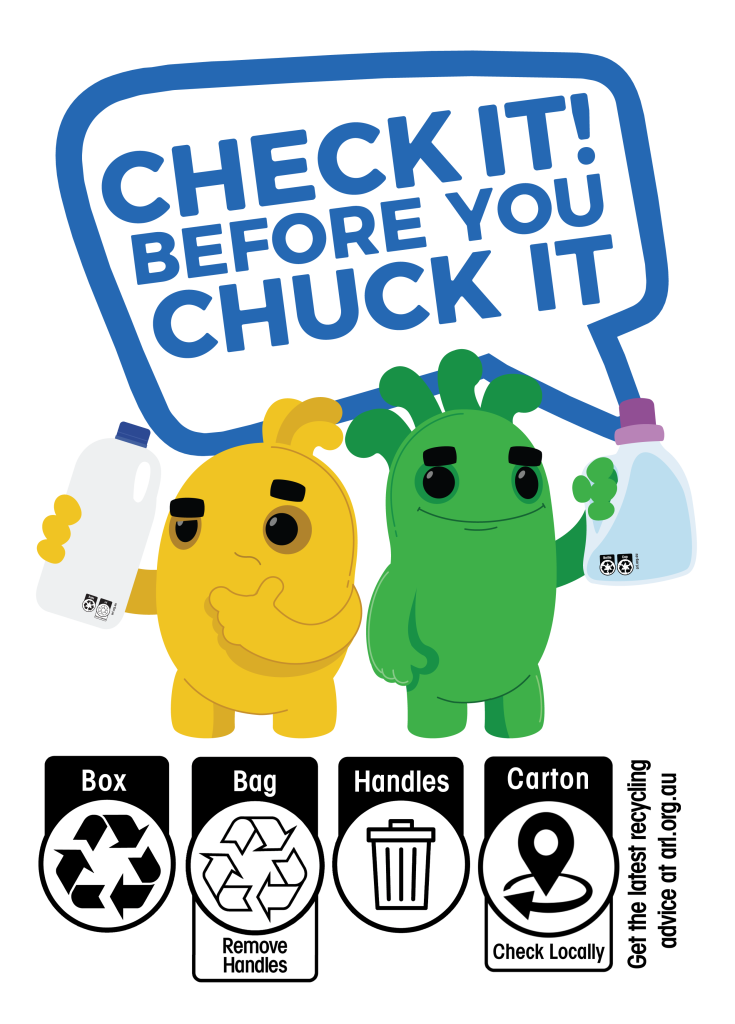
Source: Australian Recycling Label, ARL Resource Tool Kit
“One way to help you recycle correctly is to follow the phrase, ‘If in doubt, leave it out’…If you’re not sure if an item can be recycled, don’t put it in the recycling bin”
– Australian Government, Department of Climate Change, Energy, the Environment and Water
Common mistakes
❌ Recycling only works when materials are kept separate. Items like plastic-lined coffee cups, laminated paper, and bubble-wrap envelopes made with paper can’t be pulled apart, so they end up as waste.
❌ Packing recycling up in bags. This causes contamination and can send your recycling to landfill. Instead, pack your recycling loose.
❌ Wishcycling—this is when we are unsure about whether we can recycle something, so we put it in the recycling bin and wish for the best!
Our most asked questions
👉 How clean does my recycling need to be?
Before you get scrubbing your empty cans, please read on:
If a recyclable item is a little bit messy or soiled, don’t just assume it goes straight to the bin!
- Items such as jars, cans, bottles, sauce bottles, party plates, yoghurt and icecream containers, and other similiar items: Scrape away food scraps, a light rinse is optional. Small traces won’t affect recycling.
- Pizza boxes: Check if your council accepts them. If yes, remove food scraps (and cardboard mat if there is one). No solid food should remain.
👉 What about bottle and glass jar caps/tops/lids?
These cheeky little fellas can be a bit of a recycling conundrum! Generally speaking, bottle and glass caps/tops/lids are too small for most curbside recycling bins. In many local councils, they must be removed from the bottle before it can be recycled.
If your local council does not accept these, seek out an alternative recycling option, such as your local micro-recycler, Lids4Kids, BRAD(Banish) or Bottle Top Hill (Perth).
⭐ SUPERSTAR TIP
👉 What is the best way to dispose of batteries?
Battery waste is a growing issue and could exceed 136,000 tonnes by 2036. Batteries should never be put in your household waste or recycling bins—doing so “poses a threat or risk to public health, safety and/or the environment”. When placed in the wrong bins, batteries can leak and detoriate, causing fires in garbage trucks and waste facilities. Furthermore, many battery components can be reused if recycled correctly.
AA, AAA, C, D and 9V batteries: Recycle any brand through national scheme, B-cycle. Find a local drop-off at places such as Aldi, Coles, Bunnings, Battery World and Woolworths.
Car/vehicle batteries: recycle through Century Yuasa, ask your local workshop, scrap metal dealer and service station if they will accept car batteries for recycling, or ask roadside assistance if they will take your old battery when replacing. Some local councils provide household hazardous waste or chemical collection programs that accept used lead-acid batteries for recycling.
Levelling up your recycling game
It is not just about what you recycle, but how you recycle it!
✅ Small things—generally, items smaller than your fist cannot be tossed into your recycling bin.
✅ Get to know your plastics—not all plastics can be recycled! (see plastics section above)
✅ Keep your recyclables loose in the bin—they do not need to be bagged up.
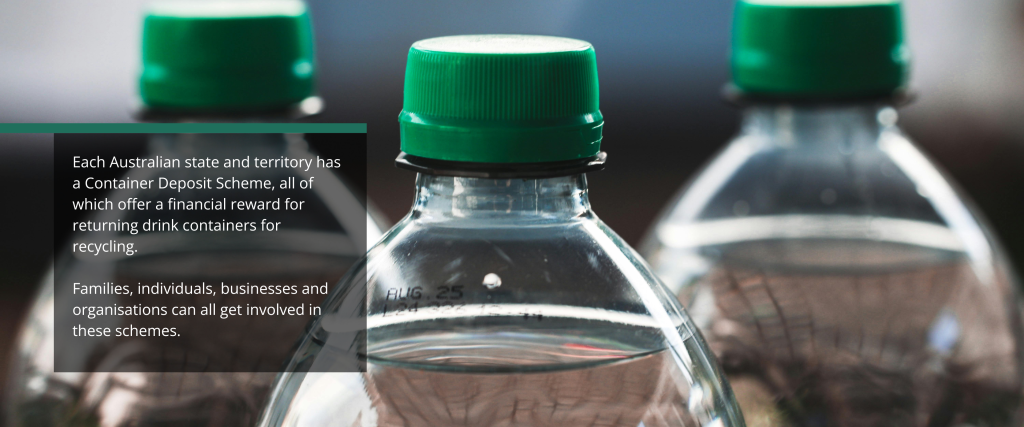
✅ Recycle your containers and earn or donate money! Each state has a Container Deposit Scheme where you can recycle: most aluminium, glass, plastic and liquid paperboard (carton) drink containers. Check below in our Resources for your state’s scheme—and get earning!
✅ If your pizza box base is too messy, you can just recycle the lid.
✅ Remove duct tape from boxes (unless your council allows tape)
✅ Pack your bin contents loosely—do not put in bags.
✅ If you are out of your home and there are no recycling bins, take your items home with you to recycle.
✅ “If in doubt, leave it out”—contaminating the recycling system can cause more harm than good.
⭐ SUPERSTAR TIP
Beyond the bin!
Take your recycling beyond the curbside bin. Your local council may not take certain items, but many programs may recycle them (or dispose of responsibly).
Visit Planet Ark’s Recycling Near You for options for items that can’t be recycled at home, such as clothing, batteries, mattresses, electronics, white goods, coffee pods, and much more!
Your community may have initiatives such as a food community pantry or a local Buy Nothing group. Facebook is often a good place to start searching for nearby groups (try searching: “your suburb/region” + “Buy Nothing”).
Here are some bonus ideas (A-Z):
💡Batteries – Recycle any brand of AA, AAA, C, D and 9V batteries through national scheme, B-cycle. Find a local drop-off at places such as Aldi, Coles, Bunnings, Battery World and Woolworths. Recycle car/vehicle batteries through Century Yuasa.
👉 Read more on batteries, and how they are a disposal hazard.
💡Cardboard boxes – Remove labels, staples and tape, and use these as weed barriers in your garden!
💡Clothing & textiles – Op-shops will take resellable clothing and shoes, but you can also recycle through schemes such as UPPRAREL, SCR Group, The Textiles Recyclers Group, Terracycle, (some of these are at a cost) and many local councils also run regular/annual free textile recycling drives.
💡Food waste – FOGO (Food Organics and Garden Organics) bin, or wormfarming and composting! And reduce your food waste in general.
💡Op shop (charity shop) – Clothing, shoes, accessories, linen, homewares, kitchenwares, and sometimes electrical goods. Please check with you local op shops to see what items that they accept.
💡Printer cartridges – Recycle through Cartridges 4 Planet Ark. There are many locations to drop-off, such as all Officeworks, and participating Australia Post, Cartridge World, Harvey Norman, The Good Guys, JB Hi-Fi, Office National and Office Products Depot outlets.
💡Terracycle – offers a range of free programs for ‘hard to recycle’ items.
💡Textiles – see Clothing & textiles above.
💡Toothbrushes & toothpastes– see Colgate Oral Care Free Recycling Program. Box up and send your toothbrushes and toothpastes (+ other eligible detail products) or find a local drop-off.
Our Call to Action: Recycling Superstars Unite!
You’ve got this. We’ve got this! It will take a united effort to combat Australia’s waste problem, from
If we take responsibility for our waste, make mindful choices and take considerate action, then we can turn the tide on our collective waste dilemma.
And don’t forget—check with your local council for the finer details of your area.
Happy Recycling!
♻️ Further Resources
Australasian Recycling Label – For more about the ARL recycling labels.
Australian Beverages | Container Deposit Schemes – For more about your state’s container deposit scheme.
Planet Ark | Recycling Near You – To discover what you can put in your curbside recycling bin, and find recycling options for items you can’t recycle at home.
Recycle Mate – A free, community-driven smartphone app (and website) developed by the Australian Council of Recycling (ACOR) that provides accurate, localized information on how and where to recycle or dispose of items anywhere in Australia.
Sustainability Victoria | Where your recycling goes – To get a great overview on the recycling process.
Terracycle – Recycle the Unrecyclable!
♻️ Further Resources—For the Superstar Kids!
ABC Kids | Recycling – Vinnie and his detective friends investigate where paper and plastic go after it’s collected from the bin.
Keep Australia Beautiful – Register and organise a clean-up day at your school
City of Monash | Kids Recycling Book – A great, printable PDF book all about recycling.
Planet Ark | Recycling Near You—Resources – A great bunch of free game sheets about recycling.
Terracycle – Fundraise for your school!
Whitehorse City Council | Kids Recycling Book – A great, printable PDF book all about recycling.
♻️ Even More Resources—For the Superstar Teachers!
Keep Australia Beautiful – Register and organise a clean-up day at your school
Planet Ark | Recycling Near You—Lesson Plans – Lesson plans for educators from Early Learning to Year 10.
ResourceSmart Schools Waste Module – Conduct an audit on your school’s waste management.
Susainability Victoria—Cirriculum Links
🥫🫙 Container Deposit Scheme (CDC) for your State
Australian Capital Territory – Container Deposit Scheme
New South Wales – Earn and Return
Northern Territory – Container Deposit Scheme
Queensland – Containers for Change
South Australia – Container Deposit Scheme
Tasmania – Recycle Rewards
Victoria – Container Deposit Scheme
Western Australia – Return Recycle Renew

Related Posts